September 13, 2015

Marjorie Schwarz at Goss-Michael Foundation


(You can click on the images for larger versions; and apologies to all for the hasty photography.  Also, fwiw, Google's replacement interface for Blogger has been greatly improved since the last time I posted, but at least for me remains more difficult to work with; e.g., the layout of this post is not all I'd like.)

We’re looking at thirty-five paintings of photographs.  Concerns regarding media and translation are of course evoked.

The photos are mostly head shots.  Many look like annual school photos; but the figures are often off-center.  This could in some cases be because the original photos were casually or amateurishly shot – e.g., the top half of one figure’s head may have been cut off in the original photo – but in at least some others, it must have been a choice by the artist, e.g, when a disembodied head floats off-center within the picture space.  The odd framing reminds us that we’re looking at an artifact, as well as enhancing a sense of disjointedness and displacement in time as well as in space.


More noticeably, nearly all the figures are literally decontextualized, their backgrounds distinctly if not solidly blacked out, with the edges of the figures sometimes limned sharply against the background and at other times blurred; or, in two paintings, the figures appear, sharp-edged, against winter white-ish backgrounds.  But the figures nearly all look relatively “cut out” or separated from their background.  One effect is not just to focus attention on the “subject,” but also on the insistent focussing on it, i.e., on the choice or process of over-emphasizing the distinctness of the figure.  This might refer in part to our cognitive and psychological operations or predispositions in viewing “portraits”; I also found it difficult not to read the overall effect as suggesting alienation and/or dysphoria.


Yet efforts to bring into focus the figures themselves are defeated by carefully calibrated degrees of blurriness which obscure the details, to a greater or lesser extent, or prevent recognition altogether.  Sometimes the blurriness consists in an explicitly painterly roughness; at other times, it’s “photographically" blurred or smeared in a manner reminiscent of some of Gerhard Richter’s work; and the colors used in the subjects’ faces are often muted.


Emotions and idiosyncratic features sometimes seem nonetheless poignantly clear; but in some cases, the subject is rendered monstrous, or even abstract.


In contrast, some of the clothing is rendered in relatively crisp detail or heightened color.  The often subtly colored blurriness of the faces contrasts with the “cut out” aspect of the figure and the relative crispness or vividness of some of the clothing.

The color palette is subtly luscious, sometimes seeming muddy at first glance but on closer inspection satisfyingly sophisticated, occasionally spiked with odd or firey hues in ways that seemed both substantively suggestive and aesthetically inspired.

There is also a pronounced juxtaposition of disparate painting techniques, which might be considered postmodernist but again calls attention to itself, although the different techniques also seem strategically selected for the particular areas in which they’re used.


A number of the paintings are variations on the same photographs (see many of the images above, including, e.g., compare the outline of the figure with red sleeves resting along the bottom of the picture frame with the outline of the “floating” baby head shown near the beginning of this review); but the clothing, hair color, and facial features are morphed to greater or lesser degrees, as if suggesting, e.g., different realities in alternate universes, or realities that might occupy the same space at different times, or just different aspects of the subject (or the photo of the subject) as conjectured and/or expressed by the artist.  It should be mentioned, however, that the paintings seemed to be hung in an order that obscured shared photographic sources.


Many of the images are of children probably too young to be self-conscious, but others seem more aware; and the poses of adults in two paintings seem almost theatrical – as if both heads were cut out from a photo in which a man looked down at a seated woman who looked up, returning his gaze in a stereotypically loving pose – but an uncertainty as to the full meaning of their facial expressions seems emphasized by the manner in which they’re presented.

A last piece hung by itself around the corner is all but impenetrable – I was reminded of Rembrandt’s self-portraits; but this is much darker and murkier, as if the blackness of the backgrounds in most of the other paintings had finally engulfed the figure.  At first glance, the head does not seem “cut out” from its context – it’s barely distinguishable at all, from its background or otherwise – yet closer inspection reveals a relatively sharp edge of darker paint delineating at least part of its outline – although both head and background are further obscured by sheer, lighter streaks hanging like haze between the painting's "subject" and its viewer, an effect atypical of this group of paintings.

This richly complex body of work certainly complicates portraiture, while evoking thoughts about the accidents and deteriorations of photographic records and memory, as well as of intramedia translation; the relationships among subjects (that peculiarly ambiguous term), grounds, and contexts; processes of cognition and recognition, including our efforts to identify and define ourselves and others in the moment and over time, and how the results are intensified or contorted by emotion; the complexity and ultimate unknowability of individuals even when with us in person, and how a well-focussed photo seems to freeze reality in the moment, yet how even within the instant, Heisenbergian uncertainties swirl while a non-existent present continually passes; the seeming impossibility of ever penetrating to some more stable, underlying reality . . .

Schwarz's paintings seemed to me beautifully strange and among the most interesting I’ve seen in a long time.  Thanks to Goss-Michael for bringing them together and providing an opportunity to get a fuller appreciation of Schwarz’s multiplicitous methods and concerns.

(The exhibition ran May 7, 2015 - June 30, 2015 at Goss-Michael Foundation, 1405 Turtle Creek Blvd., Dallas.)

September 12, 2015

Belated, Shameless Plug: The Dallas Medianale


The Dallas Medianale 2015 comprised installations, screenings, and intermedia performances at the MAC, Dallas, showcasing works by internationally renowned artists.  Works ranged from iconic achievements in early video art to immersive performances radically repurposing obsolete video technology, curated by Michael A. Morris, Danielle Avram Morgan, Charles Dee Mitchell, and moi.

Artists included !MedienGruppe Bitnik, Francis Alÿs, Cécile B. Evans, Kyle Evans + James Connolly/Cracked Ray Tube, Harun Farocki, Gary Hill, Liz Larsen/LZX Industries, Dani Leventhal, Jodi Mack, Sean Miller, My Barbarian, Bruce Nauman, Tara Nelson, Laure Prouvost, Sheila & Nicholas Pye, Jennifer Reeder, Michael Robinson, Lillian Schwartz, Joe Sola, Micah Stansell, Deborah Stratman, Harm van den Dorpel, Stan Vanderbeek, Addie Wagenknecht & Pablo Garcia, John Whitney, and many more.

Details including press here.  Look for the bi-annual event to reappear in 2017. 

January 13, 2013

Sayonara for Now


As expected, Grrrgle has not relented and restored the Blogspot user interface (see here); so, for that and other reasons, I've decided to take an indefinite hiatus from this blog.

If Grrrgle had any real imagination, they'd have offered bloggers the opportunity to purchase access to the old interface for a monthly fee.  I'm sure a lot of bloggers would have taken them up on it, and Grrrgle could have made more money than they do on whatever cost savings or data mining they hope to exploit by forcing us onto the new interface.

This blog was begun in April, 2007, this is my 1,426th post on it, and Grrrgle tells me that, as of when I more or less stopped posting last fall, c-Blog was averaging some 4,000 unique viewers per month.

Thank you for your valuable attention through the years.  I'll continue to work on various other projects, of course, and hope that you too will keep up the good work of helping to re-create our joint art project, the world. 

To the Batcave! 

November 21, 2012

[Not sure if this post had a title?]


Dan Colen, TBT, 2012, concrete filled whoopee cushion, 16.5 x 13 x 7 inches. At OHWOW's It Ain't Fair 2012, Art Basel, Miami.

October 14, 2012

Critical Art Ensemble


You can tell I'm researching for a curatorial project.

Just came across this from CAE, re- their 2012 project, Winning Hearts and Minds, presented at documenta 13:
War zones are as instructive as they are destructive. Since Vietnam, they have beautifully illustrated the contradiction between capitalism and democracy. . . . The establishment of global democracy has never been a goal of global capital. Its preference is for an authoritarian plutocracy that can be labeled a democracy. This is why the psy-ops principle of “winning hearts and minds” could simultaneously exist with the military strategy of “search and destroy.” Now that winning hearts and minds is not just US policy, but NATO policy, we can see it at work in every conflict in which NATO members have a stake; in every case, the idea of winning over the people through the alleged establishment of democratic institutions never has to be reconciled with unprovoked invasion, house-to-house searches, assassinations, torture, or drone attacks . . . .

Cultural institutions in capitalist nations reflect this same disturbing set of contradictions and relationships. In the field of visual arts, museums tend toward a support of plutocracy through collection building and maintaining the value of collections by functioning as a parallel track to the art market. Institutes, Kunsthalles, and major festivals function as corporate alibis for good cultural citizenship, and too often function within the frame of research and development of cultural products in the service of profit and enterprise. At the same time, these institutions have their democratic side, which usually appears in the form of community outreach, public programming, or education programs. These programs are generally the most impoverished, but are staffed by those who genuinely want to create events promoting social change (and are willing to accept poverty as a given condition to do it). This blend of having few resources together with a strong sense of volunteerism leads to the development of low-cost public events that are subsidized by the free labor of those who create them. Or to put it another way, the poor subsidize the creation of a false alibi that signifies the beneficence of [the] plutocracy. And yet, on an immediate person-to-person level, the results of such performances, exhibitions, and events can be inspiring and culturally valuable.
 * * * * *
Two weeks before the festival started, we issued a call for proposals to use the space for one hour each day at noon; there would be one hundred lunchtime events over the one hundred days. Proposals poured in from around the world. Even though we told those who applied that there was no financial support, and even worse, that they would have to bring all their own equipment, the program filled in a matter of weeks. Most of the events we chose were not curatorially viable (which is not to say we didn’t think they were good projects). As usual, the poor and the marginal were subsidizing the wealthy with free programming.
More at Critical Art Ensemble's website.

Soda_Jerk Re- Copyright


Soda_Jerk's site is here.

To Google and My Readers


The new blogger interface imposed by Google is an unmitigated disaster.

I'd have liked to post my curatorial essay re- Expanded Cinema here, but it's apparently become impossible to format it correctly unless I first take the time to learn whatever code it is that Google's now using. Searching for help, I get 11,099,961 hits of "I hate the new blogger interface."

Since I won't be blogging much during the next couple of months anyway, I've decided to defer any drastic action 'til year-end in the hope that Google might perhaps either restore the Blogspot interface or fix some of the biggest problems created with the new one.

But bottom line: if Google doesn't fix the problems by then and I'm going to be forced onto a more Wordpress-like platform, I might as well port to Wordpress, where I can have my privacy.

October 8, 2012

R. Luke DuBois

Doing some curating for my next project, Co- Re-Creating Spaces, an exhibition opening on Nov. 17 at CentralTrak (in Dallas, TX), and enjoying the research.

The artist explains,
Kiss takes 50 iconic embraces from the history of cinema and re-animates them through a non-photorealistic rendering technique developed by the artist. The technique analyzes the footage by looking at details in the source that resemble the lips of the kissing actors and redrawing them with points tinted to match the colors of the original film. Because the computer schematizes lips in a mathematically abstract, and not particularly accurate, manner, all sorts of details fit this criteria, causing the software to highlight not only lips but hair, details in clothing, and portions of the cinematic backdrop. The artist then creates a vectorization of these 'points of interest' akin to a cats-cradle, connecting all the dots to create a work of moving string-art that entwines the actors performing the kiss in a new, geometric embrace of connecting lines. A deliberate misuse of computer vision, Kiss evokes the embrace-as-viewed, tracing the trajectory of our gaze with an abstract connectivity akin to our mirror neurons firing when we feel the romance underneath these cinematic objects. The soundtrack of the piece subjects the non-diegetic soundtrack of the kissing scenes to an auditory time-lapse effect, creating a feedback network that underscores and propels the imagery.

September 24, 2012

Fight Bite - Charlotte Iris

Seriously, Google has made it very difficult for me to even get in here to post, let alone format anything.

Anyway, quick share:

(Thanks, Sally!)

September 22, 2012

I've Got the Pwr


(Thanks, Danette!)

Google Destroying Blogspot?


or just making my life more difficult. We blogspotters have been forced onto an interface that looks more like Wordpress, which as far as I can tell is clunkier and gives us less control. I've considered migrating to Wordpress before – I could host my blogs on my own server and have greater privacy, etc. – but rejected it because the blogspot user interface was superior. Google has chosen to trash that advantage.

Testing image control and positioning with the image right.

Ok, maybe I can get used to this, but where the h*ll do I enter labels? 

September 16, 2012

"Expanded Cinema"


Sorry to be so scarce here lately; I've been working on another big project. The 25th Dallas VideoFest opens on Sept. 26 with a screening of new video art works created especially for the LED display on the exterior walls of the Omni Dallas Hotel. I'll have a new piece of my own in the program, and have also been the coordinator/compiler for it, and before that, Ben Britt and I also created a template to enable myself and the other artists to make their works. We expect the audio for the initial screening to be simulcast on public radio KXT 91.7 FM public radio.

The show is called Expanded Cinema, in honor of pioneering new media art theorist Gene Youngblood (whose seminal book by the same title is seen as the first to propound video's potential as a fine art medium, and who will speak at the Dallas Museum of Art as part of the fest on Sat., Sept. 29). (Image left shot by Danielle Georgiou at a test screening.)

The show will include works by 14 artists selected by Bart, Michael A. Morris, and me, including Kari Altmann, Frank Campagna, Tim Capper, Rebecca Carter, Jeff Gibbons, Andrea Goldman, Mona Kasra, Kyle Kondas, Phil Lamb, Shane Mecklenburger, Mike Morris, Edward Setina, Jenny Vogel, and me. Expanded Cinema starts at 8:00 PM; pls watch for announcements re- a viewing location (generally, the best views will be from the south near the Houston St. Viaduct and Jefferson St. Bridge, along the far levy from the hotel).

The remaining 4 days of the 25th Dallas VideoFest will take place at the Dallas Museum of Art. The all-fest pass is a steal at $50; tickets here. In past years there've been some 250 videos to choose from; I think there may be slightly fewer this year, but with perhaps a greater proportion of the kinds you might find in an art gallery, for what that's worth, since I, Mike Morris, and Dee Mitchell helped curate in addition to the festival Director, Bart Weiss.

PS: I wrote an article for art+seek in honor of the 25th VideoFest, here, discussing some of my favorite videos shown at VideoFests past and how they relate to some of my favorites in the present, including works by Cindy Sherman, Sadie Benning, Martha Rosler, Mary Reid Kelley, and many more.

UPDATE: You can now see the piece I made for the program, Braille, here. More info about Expanded Cinema and the works in it here.

I Love the Aesthetics of this Video

If you've never seen "Naked tourist in Japanese moat," just go (sadly, embedding is not an option).

August 29, 2012

Mars

Thanks, NASA! (More at the link.)

August 27, 2012

Dallas VideoFest 25th Anniversary Party!

I'm throwing a party tonite F-U-N it's called "Experiments in [Video]," bring everything that you own! (paraphrasing one of my fave videos brought to you by the Video Association of Dallas). And it's coming right up, on Sept. 14! But I'm not throwing it, AMS Pictures is; and you don't need to bring everything you own, just $25.

The event will feature a micro-fest of old VideoFest faves, a silent auction, and of course, a preview of what's to come at the 25th Dallas VideoFest! A panel of guests will also discuss their favorite VideoFest moments; the guests include:

Ed Bark, TV critic and blogger
Manny Mendoza, former DMN TV critic and filmmaker
Mark Birnbaum, filmmaker
moi, video artist
Katie Gimenez, Director of Networking at Plano Chamber of Commerce (and former DVF Festival Coordinator)
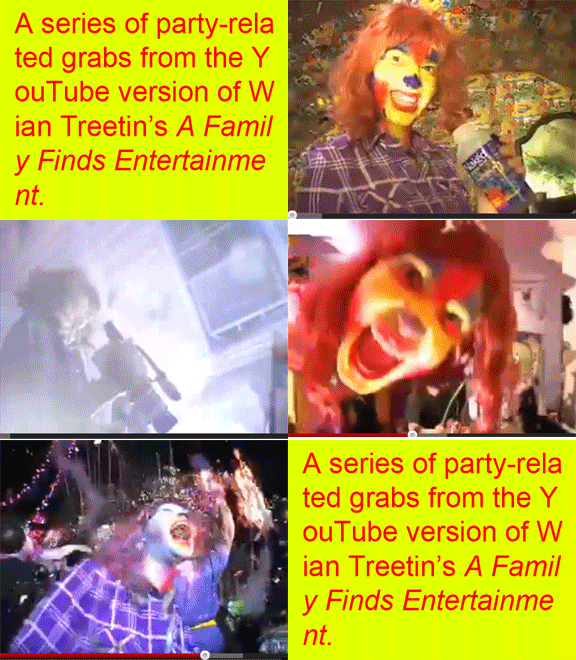
Come get prep'd for the fest, help re-create the world as a more interesting, fun place (another quote from Treetin: [s]how me something beautiful and I will go on) by contributing to a great organization, and party! – more info here, and tickets here!

August 24, 2012

Back to the Future of Video Art

The history of video art includes lots of wonderful work, much of which is rarely seen; but you'll have a few chances to catch up soon.

First, the Power Station will host four nights of video art from the past thru the present:

Aug. 30, video art from the 70's, selected by Mike Morris;
Sept. 6, from the 80's, selected by Ben Lima;
Sept. 13, from the 90's, selected by Jenny Vogel;
Sept. 20, from the 00's, selected by Nadav Assor.
All shows start at 7:30PM; the Power Station is located at 3816 Commerce, Dallas.

Meanwhile, on Sept. 14 at 7PM, AMS Pictures will host a 25th anniversary bash for the Dallas VideoFest featuring 3 rooms with screenings of favorites from past festivals, a panel briefly discussing their faves, and a program previewing Director Bart Weiss's picks from this year's festival. Tickets to this fundraiser are only $25 per person or $40 per couple.

And that brings us to the Dallas VideoFest itself, which is making new history by opening on Sept. 26 with a program of video art works created especially for and displayed on the four curved walls of the Omni Hotel, Dallas.

The remaining 4 days of the festival, most of which is dedicated to contemporary works, will take place at the Dallas Museum of Art. The all-fest pass is a steal at $50; tickets here. More details about the VideoFest to come.

August 19, 2012

New DB12

The new volume, curated by Stephen Lapthisophon, is up here.

Route Opened for Donations to Wikileaks

Per WL Central,

After almost two years of fighting an unlawful banking blockade by U.S financial giants VISA and MasterCard, WikiLeaks has announced it is back open for donations.

After WikiLeaks' publications revealing U.S. war crimes and statecraft in 2010, U.S. financial institutions erected a banking blockade against WikiLeaks wholly outside of any judicial or administrative process. The blockade came during a time of substantial economic growth for WikiLeaks but blocked over 95% of donations, costing the organization in excess of USD 20M.

The Wau Holland Transparency Reports for WikiLeaks' finances, released today, illustrate the financial consequences of 18 consecutive months of economic censorship. For the year 2011, the blockade resulted in WikiLeaks' income falling to just 21% of its operating costs.

WikiLeaks has been forced to run on its cash reserves at the Wau Holland Foundation, which have diminished from EUR 800K at the end of December 2010, to less than EUR 100K at the end of June 2012. As the graph shows, WikiLeaks' reserve funds will expire at the current austere rate of expenditure within a few months. In order to effectively continue its mission, WikiLeaks must raise a minimum of EUR 1M immediately.
More at the link above. You can donate here – that's direct from WL Central and should be reliable; I just donated.

And Now for Some Nomi:

August 18, 2012

Dallas VideoFest 25

. . . makes a big entrance with a program of new video art created especially for the nearly 200-foot high display system on the exterior walls of the Omni Hotel, Dallas, at 8:30PM on Wednesday, Sept. 26 . The program is entitled, Expanded Cinema, borrowed from the 1970 book of the same title by seminal new media theorist Gene Youngblood (see also this previous post), who will give a lecture at the festival, Secession from the Broadcast: The Internet and the Crisis of Social Control, at 3PM on Sunday at the DMA, Horchow Auditorium.

The image right is from OMNEY, one of the videos to be included in Expanded Cinema, by Shane Mecklenburger, who provided the transcription of Youngblood's talk at the latter link. The Omni display completely wraps the building; hence the weird aspect ratio. (Full disclosure: I'm helping to organize the program and will have a piece in it.)

Because of the unique characteristics of the Omni "screen," most of the artists had to re-invent their approach to an extent perhaps greater than usual, in order to create works that might exploit the potential of this new platform while adapting to its requirements and continuing to explore the concerns with which they prefer to engage in their aesthetic practices. They have risen to the challenge, and the resulting works are gorgeous and fascinating.

The rest of the VideoFest will be at the Dallas Museum of Art, Sept. 26 - 30; block out your calendar! It's shaping up to be one of the best fests yet. As the dates approach, I hope to post more details here, including a chronological schedule with program descriptions all in one page.

But go ahead and buy tickets for the fest (I recommend full immersion), find more info, or (please!) donate at videofest.org. You can also donate via Kickstarter here.

Here's an auditory blast from the past, ca. early Gene Youngblood . . .